Labs Who Care: Towards Sustainable Laboratories Workshop

This free, hybrid event is proudly organised by the ANFF Sustainability Expert Working Group. As you may remember, last year we launched Labs Who Care, a movement and community focused on integrating sustainability into all aspects of lab life. This year, we’re building on that momentum with new collaborations, including with Australasian Campuses Towards Sustainability (ACTS), who have recently launched a Lab Sustainability Group.
Whether you’re curious, sceptical, this workshop is a space to explore practical strategies, hear from peers, and contribute to shaping the future of environmentally responsible science.
Why attend?
– Learn how sustainability can be embedded in lab operations and research (hear from other labs)
– Be part of a growing movement within ANFF and beyond
Workshop Program
This year, we have an exciting lineup of speakers! You can view the latest version of the program here.
Event Details & Registration Links:
Monday, November 10, 2025 – 9:30 to 15:00 (AEDT)
– In-person event held at The University of Melbourne (Melbourne Connect Building), 700 Swanston Street, Carlton, VIC. Click here for In-person registration link
– Online event via Zoom. Click here for online registration link
MSE-MCN Distinguished Seminar – Body-Interfaced Biosensors
The rise of personalized medicine is reshaping traditional healthcare, enabling predictive analytics and tailored treatment strategies. In this talk, I will discuss our progress in developing wearable, implantable, and ingestible electrochemical biosensors for real-time molecular analysis. These bioelectronic systems autonomously access and sample diverse body fluids—including sweat, interstitial fluid, gastrointestinal fluid, wound exudate, and exhaled breath condensate—enabling continuous monitoring of key biomarkers such as metabolites, nutrients, hormones, proteins, and drugs during various activities. To facilitate scalable, cost-effective manufacturing of these high-performance, nanomaterial-based sensors, we employ laser engraving, inkjet printing, and 3D printing techniques. The clinical utility of our biosensors is being evaluated in human and animal studies, focusing on applications such as stress and mental health assessment, precision nutrition, chronic disease management, and personalized drug monitoring.
Additionally, I will highlight our efforts in energy harvesting from both the body and the environment, opening the door to battery-free, wireless biosensing technologies. By integrating electrochemical biosensing with advanced bioelectronics, we aim to revolutionize personalized healthcare, offering new possibilities for diagnostics, continuous monitoring, and therapeutic interventions.
This is an in-person-only seminar, jointly organised by Monash School of Engineering and Melbourne Centre for Nanofabrication
Professor Wei Gao
California Institute of Technology, USA
10:00am, 06/11/2025
G29/G30, Ground Floor, New Horizons – 20 Research Way, Clayton
Click here for more information
4th DWL Workshop
Registration open for: DWL Workshop and Webinar Series
The 4th DWL Workshop, proudly sponsored by ANFF, will be held on Monday February 2, 2026, at the University of Sydney. Join researchers, scientists, and micro/nanofabrication experts for this one-day event exploring the latest in direct write lithography (DWL) including electron, photon, ion beam and more! Educational webinars will also begin in November 2025.
Click here to register and for more information
Want to present at the workshop?
We’re calling on researchers, scientists, and experts in micro and nanofabrication to share their insights at the “Innovative Research in Direct Write Lithography Workshop.” If you’re working on new techniques, applications, or advancements in direct write lithography, we want to hear from you. For details on how to submit your abstract, click here.
* Please be aware that the webinar you’ll be watching is a pre-recorded session. After the presentation, there will be a live Q&A segment.
Keynote speaker at the 4th DWL Workshop:
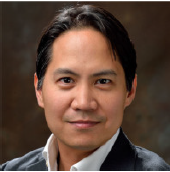
Gerald G. Lopez, Ph.D. Director of Operations and Business & Center Associate Director Singh Center for Nanotechnology
University of Pennsylvania | MAEBL Co-Founder and Board Chair | EIPBN Operations Trustee
ANFF-C Seminar Series: Manufacturing for Startups
ANFF-C is pleased to announce that Dr Catherine Lopes will present this upcoming webinar. Dr Catherine Lopes is a renowned leader in Data & AI, with over 25 years of experience driving innovation, governance, and transformation across banking, energy, consulting, and government sectors. She is currently the Chief Data and Analytics Officer at Merkle ANZ and serves as a Non-Executive Director on the governing board of the Environment Protection Authority Victoria (EPA). Catherine has founded and directed multiple startups focused on data strategy, analytics, and empowering women in technology, including Opsdo Analytics and Ada’s Tribe.
Her expertise spans strategic data management, machine learning, and ethical AI, and she is a sought-after advisor for startups and institutions aiming to embed human-centric AI into scalable solutions. Catherine is also an active mentor, bridging academia and industry, and serves on advisory boards at leading universities. She was awarded the Mollie Holman Medal for her doctoral research in Machine Learning at Monash University in 2005. Catherine is recognized as one of Australia’s top analytics leaders and is a finalist for the Women in AI ANZ award.
5:00pm, 29/10/2025
Webinar – Click here to Register
Nanofabulous Seminar: Mainstreaming Lab Sustainability – MCN’s Actions, Global Relevance, Shared Responsibility
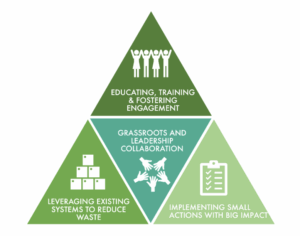
Scientific research is resource‑intensive, but it doesn’t have to be wasteful. At the Melbourne Centre for Nanofabrication (MCN), we are embedding sustainable lab practices into everyday operations. In this seminar, Dr Tatiana Pinedo Rivera will share how MCN is leading by example—raising awareness, rethinking workflows, reducing single‑use materials, and fostering a culture of care. These efforts are part of a growing global movement to reimagine how science is conducted in the face of the climate and environmental crisis. The session will explore how individual actions, when supported by strong institutional leadership, can spark meaningful and lasting change. Participants will gain practical insight into sustainability principles, implementation strategies and ways to bring these ideas back to their own labs—helping to build a more responsible, resilient research culture.
Dr. Tatiana Pinedo Rivera
Senior Process Engineer & Team Lead
Melbourne Centre for Nanofabrication (MCN)
10:00am, 02/09/2025
Melbourne Centre for Nanofabrication
151 Wellington Road, Clayton, 3168
Zoom link: click here
Meeting ID: 854 9794 7277 and passcode: 690216
Click here for more information
1st Australian Workshop on 2D-Printed Devices
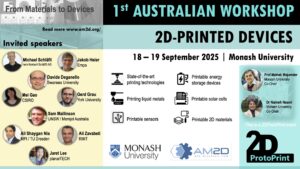
Monash University, ARC Reseach Hub – AM2D and 2DProtoPrint will be hosting the 1st Australian Workshop on 2D-Printed Devices on 18–19 September 2025. The event is free to attend and open to PhD students, early-career researchers, and professionals working in printable electronics and materials. The program will cover cutting-edge topics including:
- Printable sensors / energy storage/solar cells
- 2D materials & liquid metals
- State-of-the-art printing techniques
The workshop is hybrid, so participants can join online — though we’d love to welcome them in person, especially for the Day 2 hands-on session.
Certificates of participation will be available.
Registration details: https://am2d.org/
Program Flyer: here
Nanofabulous Seminar: Toward Autonomous Science: Nanotechnology and the Rise of Self-Learning Machines

This lecture explores the dynamic interplay between artificial intelligence (AI) and nanotechnology, highlighting how each drives the other forward. While AI accelerates material discovery, sensing, and diagnostics, nanotechnology enables the development of advanced hardware such as neuromorphic and quantum systems. Together, they are paving the way for the 5th paradigm of science, where machines autonomously generate knowledge, design experiments, and interpret data with minimal human input. Case studies in biosensing and image analysis illustrate these trends. The lecture will also address the societal implications of this shift toward machine-led scientific discovery.
Prof Osvaldo N. Oliveira Jr.
Director, the São Carlos Institute of Physics
The University of São Paulo, Brazil
10:00am, 31/07/2025
Melbourne Centre for Nanofabrication
151 Wellington Road, Clayton, 3168
Zoom link: click here
Meeting ID: 874 0886 6047 and passcode:971252
Click here for more information
Nanofabulous Seminar: Development of Smart Micro-/Nano-formulations for Tumor-targeted Delivery

Treatment of tumors has been less desired due to the presence of tumor microenvironment (TME) comprising unique characteristics such as pH reduction, redox imbalance, dynamic hypoxia, complex vasculature, multidrug resistance, and so on, which barricaded the delivery of medicines to tumor lesions. My research aims to establish smart micro-/nano-technological systems that could either (1) ensure a safe delivery passage for medicinal formulations to penetrate the TME to reach tumor sites, (2) overcoming drug efflux-based multidrug resistance, (3) remodulate TME to enhance the imaging and therapeutic efficacies of tumors, or (4) encapsulate and promote sustained drug release. Overall, my research could contribute to the oncology field by providing innovative approaches that improve the combating of tumors.
Dr. Liang Ee Low
Lecturer in Monash University Malaysia
3:00pm, 15/07/2025
Melbourne Centre for Nanofabrication
151 Wellington Road, Clayton, 3168
Zoom link: click here
Meeting ID: 837 2690 9791 passcode: 554406
Click here for more information
Nanofabulous Seminar: Unveiling the Impact of Nanoscale Membrane Deformation in Cells

Cell membranes serve as a central platform to host a variety of proteins essential for cellular activities such as cell signaling, morphogenesis, and membrane trafficking. At the same time, the membranes also undergo drastic morphological changes in a number of essential processes, such as endocytosis, intracellular trafficking, and cytokinesis, etc.
An intriguing yet challenging question to answer is whether and how the shapes of the membrane impact the dynamics of membrane proteins or the periphery proteins interacting with the membrane.
However, membrane shape changes often happen at sub-micro to the nanoscale, which is approaching the limit of conventional microscopy imaging resolution and difficult to examine quantitatively. In this talk, I will introduce our efforts in employing vertically aligned nanostructures to generate defined membrane topography in live cells and in vitro. We will discuss our findings on the membrane curvature-guided accumulation of membrane proteins, including oncogenic Ras proteins and viral proteins. In addition to plasma membrane, we also explore the nanoscale topography guidance on nuclear membrane and its implication in differentiating malignant cancer cells. We envision more new insights would be revealed by bridging advanced nanotechnology to nanoscale dynamics at cell membrane.
Dr. Wenting Zhao
School of Chemistry, Chemical Engineering and Biotechnology
Nanyang Technological University, Singapore.
11:00am, 14/07/2025
Melbourne Centre for Nanofabrication
151 Wellington Road, Clayton, 3168
Zoom link: click here
Meeting ID: 836 5781 3944 passcode: 303563
Click here for more information
Discounted MCN Residency Rates for Start-ups
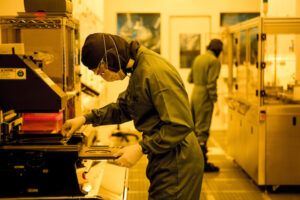
Starting May 2025, MCN is now offering discounted residency rates for start-ups.
Access rates at the MCN are subsidised for academics owing to publicly funded operational support it receives through the Federal NCRIS program. While industry users have always been asked to pay more for access than their academic counterparts, such rates can present significant financial challenges to start-up companies who are not yet able to attract funding from commercial investors.
To help lower this barrier and assist start-ups with the continued development of their devices/technologies, the MCN has introduced an application pathway for eligible start-ups to receive a 40% discount to published industry residency rates.
For eligibility criteria and how to apply, see here.