Nanofabulous Seminar: micro and nanotechnologies to direct mesenchymal stromal cell fate for tissue regeneration
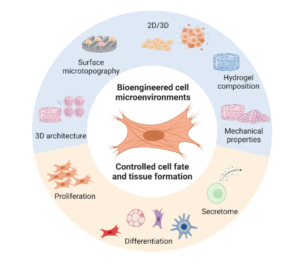
Mesenchymal stromal cells (MSCs) show great promise for a wide range of applications including treating graft-vs-host disease, rheumatoid arthritis and cardiovascular diseases, as well as in tissue-engineering. This can be attributed to the direct differentiation of MSCs into the cells that form tissues such as bone or cartilage, or the activity of the factors that MSCs secrete which can have powerful regenerative properties.
MSC properties are tightly regulated by cues from their surrounding microenvironment, including physical cues such as substrate mechanical properties, ligand presentation and architecture. Bioengineered systems therefore gave a huge role to play in building essential understanding of how the cells respond to different physical cues, as well as in developing new technologies that harness these effects to promote tissue repair. Our research investigates the effects of physical stimuli on the properties and function of MSCs, including effects of substrate mechanical properties, surface micro and nano-topography and changes from 2D to 3D. We then apply this knowledge to improve the design of systems for MSC differentiation and tissue formation, for example, by delivering microRNA:nanoparticle complexes to modulate mechanosensitive signalling pathways in MSCs encapsulated in hydrogels and promote osteogenesis for bone tissue engineering.
A/Prof Jess Frith
Materials Science and Engineering, Monash University
ARC Training Centre for Cell and Tissue Engineering Technologies,
Monash University
11:00am, 16/03/2023
At the Melbourne Centre for Nanofabrication Boardroom
151 Wellington Road, Clayton, 3168
Zoom link: click here
Meeting ID: 843 6652 4045 and passcode: 870817
Click here for more information
Nanofabulous Seminar: Nature meets Nanotechnology: Development of Novel Bio-composites from Renewable Resources
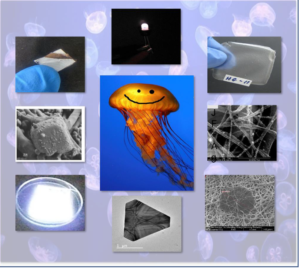
Proteins form the very basis of life. They regulate various activities in all known organisms, from replication of the genetic code to transporting oxygen, and are responsible for regulating the cellular machinery and determining the phenotype of an organism.
From a material science point of view, proteins can serve as excellent building blocks for developing new structures, composites, and novel materials. In this talk, I will cover some of our efforts in this direction, demonstrating our bottom-up technology to form various new materials, including light-emitting devices, photothermal materials, smart-wound dressing, antibacterial coating, heavy-metal sorption materials, and more. The role of Jellyfish, an important renewable resource for many of our applications, will be discussed.
Professor Shachar Richter
Department of Materials Science and Engineering
Faculty of Engineering & Center for Nanoscience and Nanotechnology
Tel-Aviv University, Tel-Aviv, Israel
11:00am, 09/03/2023
At the Melbourne Centre for Nanofabrication Boardroom
151 Wellington Road, Clayton, 3168
Zoom link: click here
Meeting ID: 883 5189 4360 and passcode: 897020
Click here for more information
Nanofabulous Seminar: Micro- and nanotopographies for biological applications
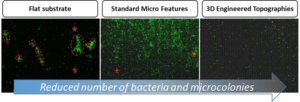
Dr Victor Cadarso from the Department of Mechanical and Aerospace Engineering and the Centre to Impact Antimicrobial Resistance at Monash University will be giving a presentation on “Micro- and nanotopographies for biological applications”.
11:00am, 07/02/2023
At the Melbourne Centre for Nanofabrication Boardroom
151 Wellington Road, Clayton, 3168
Zoom link:
Meeting ID: 826 1534 5345 & Passcode: 465451
Click here for more information
Nanofabulous Seminar: Single-electron tunneling through dopants in thin-Si devices
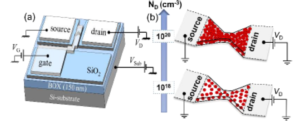
Daniel Moraru has been working on the development of a unique research direction for semiconductor nanoscale devices, aiming for atomic- and molecular-scale electronics by utilizing dopant atoms (or dopant clusters as “molecules”) in silicon. Through such research, he and his group have been contributing to the advancement of a field coined as “dopant-based electronics”. In his lab, research is performed from different perspectives, from first-principles simulations of atomistic effects to Si nanodevice fabrication and electrical characterization at the level of single-electron tunneling.
Dr Daniel Moraru
Associate Professor
Research Institute of Electronics, Shizuoka University, Japan
Faculty of Science, Swinburne University of Technology
11:00am, 02/03/2023
At the Melbourne Centre for Nanofabrication Boardroom
151 Wellington Road, Clayton, 3168
Zoom link: here
Meeting ID: 812 9011 2054 & Passcode: 443815
Click here for more information
Announcing: New ANFF-Victoria Strategic Plan

We are delighted to present ANFF-VIC’s new Strategic Plan for 2023-2028, outlining the goals we have identified as necessary in realising our node’s potential and our mission to drive development and translation of Australian innovation in the micro- and nanotechnology sectors.
This plan sets a trajectory for the next five years that builds upon the success of ANFF-VIC and the MCN whilst leveraging significant developments within local precincts such as the Southeast Melbourne Innovation Precinct (SEMIP) and aligning with the Victorian Government’s vision for next generation research ecosystems as well as with the three Strategic Pillars of ANFF.
Download the full plan here.
Upcoming Nanofabulous Seminar dates/speakers
Happy new year! The MCN’s Nanofabulous Seminar series is kicking off 2023 with a number of exciting talks. Check out the flyer link below and keep an eye on the events page for seminar details. Many more to come…
Nanofabulous Seminar: Micro-nanofabrication and Microscopy with light noble ion beams
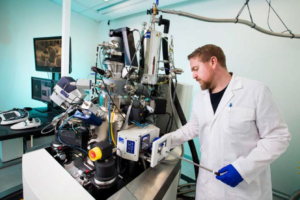
The Materials Characterisation and Fabrication Platform (MCFP) at the University of Melbourne operates a Zeiss ORION NanoFab helium ion microscope (HIM), one of only four in Australia. HIM is a scanned ion probe instrument that is similar in many respects to that of the well-established scanning electron microscope (SEM). The fundamental difference is clear in the name, with our source being one of (typically) helium ions generated from the gas field ion source, rather than electrons as in SEM. This affords benefits to the microscopist: we can image insulating materials without coating while maintaining high vacuum and high beam energy, we have outstanding surface sensitivity normally reserved for very low-kV SEM, and being an ion beam we can perform high spatial resolution fabrication switching between helium and neon as our source.
After an overview and introduction to the technique and its benefits, I will overview some of the key areas of research HIM has excelled at supporting in recent years at the MCFP and in Australia, with an aim to demonstrate cross-disciplinary applications. We will look at graphene and 2D nanomaterials, thin polymer coatings on carbon fibres, carbon nanospheres, cellular biology including bacteria and biofilms, through to micro-nanofabricated structures such as ultra-nanocrystalline diamond coatings, 2-photon-polymerisation printed structures, and plasmonic devices and nanostructured molecular gratings fabricated using the instrument.
Dr Anders Barlow
Platform Technologies Specialist
MCFP, the University of Melbourne
11:00am, 17/01/2023
At the Melbourne Centre for Nanofabrication Boardroom
151 Wellington Road, Clayton, 3168
Zoom link: here
Meeting ID: 823 4174 1876 & Passcode: 638277
Click here for more information
MCN Private Industry Laboratory — now accepting EOIs
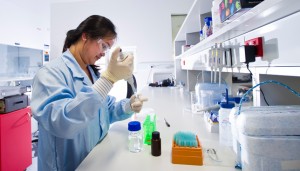
Attention startups and SMEs, MCN is now offering an option for the leasing of a small (approx. 30sqm) private laboratory, an initiative aimed at hosting translational activities leveraging a broad spectrum of MCN capability.
The laboratory has secure electronic access with a dedicated fume cupboard, essential services (e.g. power, CDA/N2, water and vacuum), bench space for 3–6 staff and ample wet/dry storage.
Link to EOI instructions here. Submissions open through 6th January 2023.
Nanofabulous Seminar: Reversible interfaces for stretchable and recyclable electronics

Soft electronic composites retain their electrical conductivity under strain. Hard, conductive filler particles are embedded in a soft, insulating matrix. Strain deforms the filler network and alters the conductive connections between the particles. Tobias will discuss the hierarchical network structure of carbon and metal fillers in printable conductive composites and discuss the role of network geometry and contact resistances. Reversibility at the particle-particle interfaces emerges as a key requirement: only if the particles can re-form electrical contacts over many cycles does the material retain its conductivity. An application from the field of smart automotive parts will illustrate typical requirements on soft conductive materials.
Reversible interfaces aid the recovery of the materials in a product’s lifecycle, too. Electronics and batteries invariably combine different materials, and their reuse or recycling generally involves separating them. Discussion how reversible, functional interfaces can make this economically and ecologically feasible and bring us a step closer to sustainability in electronics.
Prof Dr Tobias Kraus
INM – Leibniz Institute for New Materials
Saarbrücken, Germany
11:00am, 18/11/2022
At the Melbourne Centre for Nanofabrication Boardroom
151 Wellington Road, Clayton, 3168
Zoom link: here
Meeting ID: 839 3750 1277
Passcode: 145263
Click here for more information
MCN Seminar: Two-photon polymerization 3D printing for micro-/nanostructures
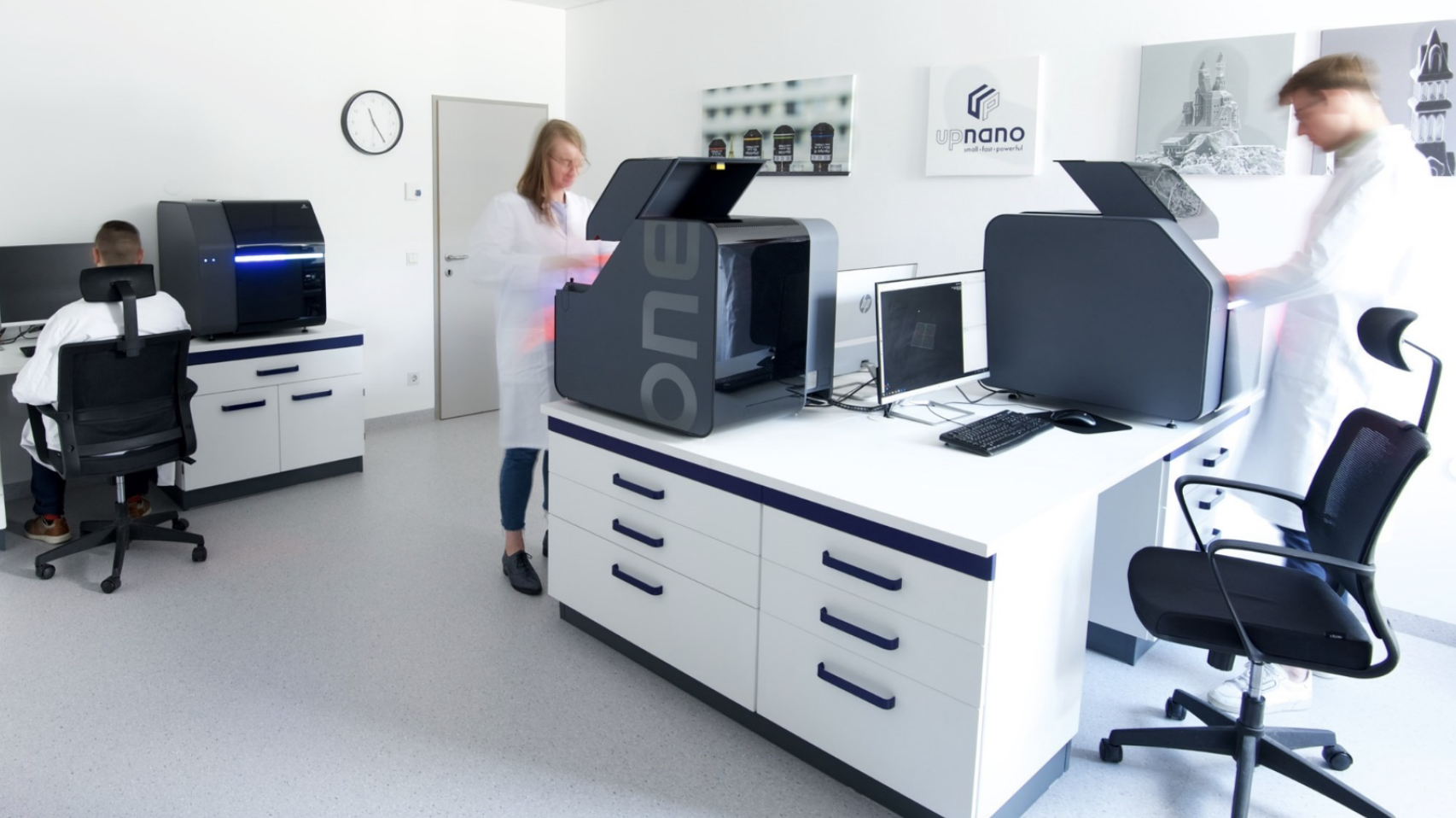
UpNano GmbH is a high-tech 3D printing company headquartered in Vienna, Austria. The company manufactures and sells high resolution 3D printers under the NanoOne platform which are capable of printing parts with a wide-range of resolutions and volumes, from 160nm lines to 40x40x40mm and 4” wafer batch production.
Typical user applications are microfluidic chips, bioprinting, microneedles, micro optics and medical devices. The combination of a very strong 1000mW femtosecond laser and the unique vat-design enables novel material development with polymers normally not associated with 2-photon printing.
Henrik Akesson is the Chief Business Officer and Head of Global Sales at UpNano GmbH. Trained as an engineer in Sweden, he spent 15 years in the Asian semiconductor and display manufacturing industry solving key issues for Samsung, SONY, LG, TSMC, Intel, SHARP and others. He was an integral part of the flat screen revolution and the continuous production achievements that were made at the time. During this work, he discovered the potential in 2-photon polymerization as a better means to create structures in 3D than the classic laser lithography. After 10 years in Germany and Austria, working in commercial, sales, and business development roles in software and 3D printing, he is now a frequent speaker and a champion for the micro-factories concept where whole production and assembly lines can be made in millimeter size for micron parts.
Henrik Akesson,Chief Business Officer and Head of Global Sales at UpNano GmbH., Germany, will be visiting MCN and giving a presentation on “Two-photon polymerization-3D printing for micro-/nanostructures”.
1:00pm, 16/09/2022
At the Melbourne Centre for Nanofabrication Boardroom
151 Wellington Road, Clayton, 3168